



12 Jan RPO vs C3PAO Which is Best for CMMC Compliance
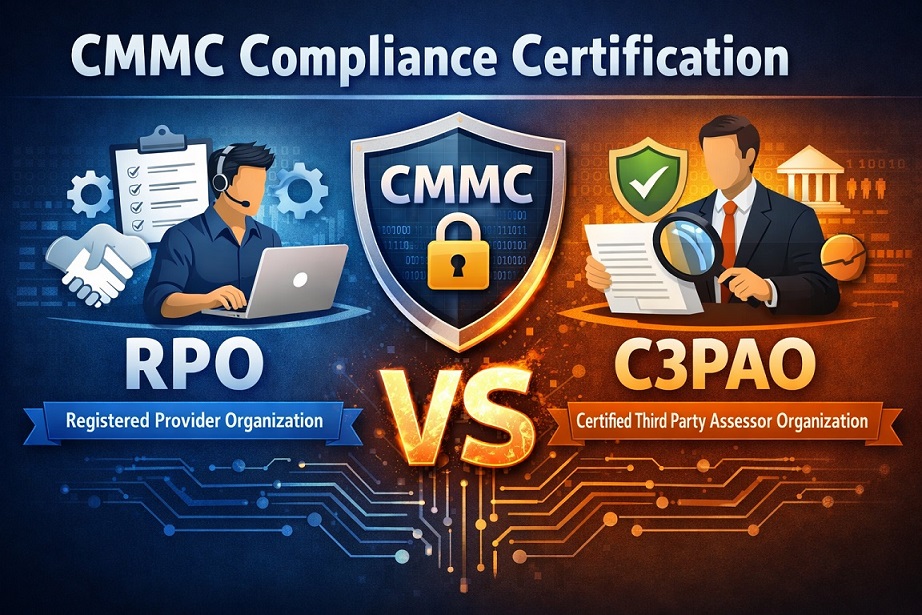
RPO vs C3PAO: Which to Hire for Your CMMC Compliance Journey?
Estimated reading time: 15 minutes
Key Takeaways
- RPOs provide readiness support, gap analysis, and remediation guidance but do not certify CMMC status.
- C3PAOs are accredited to perform official CMMC assessments and report results to DoD systems for contract eligibility.
- Hire an RPO when building compliance maturity; engage a C3PAO when contracts mandate third-party validation.
- Decision factors include current maturity, contractual requirements, timelines, budget, and in-house expertise.
- Use rigorous vetting, clear SOWs, and additional consulting options like MSSPs or independent experts.
Table of contents
Understanding the CMMC Ecosystem
CMMC is a tiered cybersecurity assurance program with three levels that map to the sensitivity of information you handle and the rigor of required controls.
CMMC Level 1 – Foundational (Self-Assessment)
Focuses on safeguarding Federal Contract Information via basic cyber hygiene practices and is typically satisfied through self-assessment, with status recorded in DoD systems like SPRS.
For details, see the DoD CMMC About page.
CMMC Level 2 – Advanced (Self or C3PAO)
Implements the full set of NIST SP 800-171 derived requirements for protecting Controlled Unclassified Information. Some contracts allow Level 2 via self-assessment, while others mandate a third-party evaluation.
- Some contracts allow Level 2 (Self)
- Others require Level 2 (C3PAO)
For the final rule, see CMMC Program Final Rule.
CMMC Level 3 – Expert (Government Assessment)
Reserved for the most sensitive CUI and involves government-led assessments (DIBCAC), not C3PAOs.
Learn more: CMMC is here: What It Means for Defense Contractors.
DoD contracting activities assign each solicitation a required CMMC level and assessment type, and you must have a current status at or above that level to win or maintain the contract.
What Is a Registered Provider Organization (CMMC)?
A Registered Provider Organization (RPO) is a company recognized in the CMMC ecosystem as a trusted advisor that provides consulting services but does not perform official certification assessments.
Definition – “registered provider organization CMMC”
In the CMMC model, an RPO is listed by the accreditation body as authorized to provide preparation services—such as interpretation, planning, and remediation guidance—but it cannot grant or deny certification status.
Typical services offered by a CMMC RPO provider
- Readiness assessments and gap analysis against the required CMMC level
- Remediation roadmapping, including prioritized plans, cost estimates, and timelines
- Policy and procedure development aligned to CMMC practices
- Technical and architectural guidance (segmentation, enclaves, MFA, logging)
- Support implementing security tools and processes
- Mock assessments and pre-audit reviews
Ideal use cases and organizational profiles
RPOs are typically the best fit when:
- You do not yet meet your required CMMC level and need hands-on help reaching compliance
- You lack in-house cybersecurity and compliance expertise
- You want a trusted guide for interpreting requirements and documenting evidence
- You are early in your journey and want to avoid surprises in a formal assessment
RPOs are particularly valuable for:
- Small contractors and subcontractors with lean IT teams
- Mid-size firms handling CUI for the first time
- Organizations facing near-term solicitations with specific CMMC level requirements
What Is a C3PAO?
A C3PAO (CMMC Third-Party Assessment Organization) is an independent assessment firm accredited to perform official CMMC assessments for certain contracts.
Definition – CMMC Third-Party Assessment Organization
A C3PAO is a formally authorized assessor in the CMMC ecosystem that:
- Conducts assessments according to DoD-defined methodology and standards
- Evaluates your implementation of required controls
- Submits assessment results into DoD systems such as SPRS
Learn more: CMMC is here: What It Means for Defense Contractors.
Scope of assessments, certification authority, and reporting
C3PAOs are responsible for:
- Reviewing documentation, technical configurations, and evidence
- Conducting interviews and testing to confirm operational effectiveness
- Generating an assessment report and scoring for DoD review
- Providing results that determine contract eligibility
See DFARS Subpart 204.75 for details.
When you need a C3PAO vs when you don’t
You need a C3PAO when:
- The contract explicitly requires Level 2 (C3PAO)
- You must demonstrate third-party validated compliance for eligibility
You generally do not need a C3PAO when your contract allows Level 1 (Self) or Level 2 (Self) and you are still preparing for a formal assessment.
RPO vs C3PAO – Key Differences
- Engagement purpose: RPO provides consulting and readiness guidance; C3PAO conducts official assessment and certification.
- Core role: RPO acts as advisor and implementer; C3PAO acts as independent assessor.
- Independence and accreditation: RPOs are recognized providers but may integrate with your team; C3PAOs maintain strict independence.
- Authority over certification: RPOs cannot grant certification; C3PAOs issue the official assessment result.
- Pricing models: RPOs often use time-and-materials or project retainers; C3PAOs charge fixed-scope assessment fees.
- Timelines: RPO engagements are flexible; C3PAO assessments follow structured windows tied to contract deadlines.
- Depth of technical expertise: RPOs focus on implementation details; C3PAOs focus on evidence evaluation and scoring.
- Relationship to your team: RPOs can integrate as partners; C3PAOs act as auditors with professional distance.
In short: RPO = coach and builder, C3PAO = referee and scorekeeper.
Which to Hire: RPO or C3PAO?
Choosing which to hire depends on your current maturity, contract requirements, timelines, budget, and internal expertise.
Key decision factors
- Current cybersecurity maturity: If you have significant gaps against NIST SP 800-171 or lack formal policies, an RPO is usually the first hire.
- Contractual requirement and timeline pressure: If a solicitation requires Level 2 (C3PAO), you will need a C3PAO assessment to remain eligible. However, engaging a C3PAO too early can cause delays (see DFARS Subpart 204.75).
- Budget and risk tolerance: RPOs allow staged investments for gap analysis and remediation, while C3PAO assessments are fixed events with higher stakes.
- In-house expertise: Strong internal teams may engage an RPO minimally and move quickly to a C3PAO; lean teams benefit from ongoing RPO guidance.
Sample decision scenarios
Scenario 1 – Small subcontractor with limited IT staff
- Handles some FCI now and expects future work with CUI at Level 2
- Current environment has basic IT, limited documentation, no formal NIST SP 800-171 alignment
Recommendation: Hire an RPO first for readiness assessment, roadmap, and implementation support. Engage a C3PAO only when a contract explicitly requires Level 2 (C3PAO) or when you are assessment-ready.
Scenario 2 – Large prime integrator with mature security program
- Existing NIST SP 800-171 program, SIEM, SOC, and governance
- Facing solicitations that specify Level 2 (C3PAO)
Recommendation: Conduct a self-assessment or targeted RPO-led review, then engage a C3PAO early to align assessment timing with proposals. Use RPO support for specific remediation as needed.
Scenario 3 – Mid-size manufacturer new to CUI
- Expected contracts with Level 2 (Self) initially; future Level 2 (C3PAO) likely
- No immediate C3PAO requirement but a sustainable Level 2 posture is needed
Recommendation: Hire an RPO to build Level 2 (Self) posture now; layer in a C3PAO assessment when readiness and budget align.
Exploring Additional CMMC Consulting Options
Beyond RPOs and C3PAOs, several consulting options can complement your approach.
Independent consultants and boutique firms
- Offer tailored, high-touch advisory services and deep subject-matter expertise
- May or may not be formally recognized as RPOs; key is CMMC and NIST SP 800-171 experience
Managed Security Service Providers (MSSPs) with CMMC offerings
- Provide ongoing security operations aligned to CMMC requirements
- Partner with RPOs for governance and C3PAOs for formal assessment
How to Select Your CMMC Partner
Whether you are choosing an RPO, C3PAO, or other advisor, apply rigorous vetting.
Vetting criteria
- Accreditation and status: confirm formal authorization for C3PAOs and recognition for RPOs
- Past performance and references from similar organizations
- Technical and regulatory expertise in CMMC, DFARS, and NIST SP 800-171 (see DFARS Subpart 204.75)
- Methodology and tools for evidence management and findings resolution
- Pricing transparency with clear scopes and deliverables
Questions to ask prospective providers
For RPOs and consultants:
- How many CMMC readiness engagements have you completed at Level 1 and 2?
- How do you handle policy development, technical configuration, and evidence collection?
- What does your gap analysis report look like, and how actionable is the remediation plan?
- How do you coordinate with MSSPs or internal IT teams?
For C3PAOs:
- How many C3PAO assessments have you completed at our target level?
- What is your assessment process and timeline, and when should we schedule?
- What pre-assessment information do you require (SSP, network diagrams, POA&Ms)?
- How do you communicate findings and scoring, and what is the dispute process?
Tips for drafting a Statement of Work (SOW)
- Clearly separate roles: RPO readiness vs C3PAO assessment scope
- Define scope by boundary to identify systems, networks, and locations
- Specify deliverables and formats, such as gap reports, policy templates, and final assessment reports
- Align with contract timelines and milestones
Conclusion and Next Steps
The decision between an RPO and a C3PAO is about “which to hire, and when.” Use the guidance above to chart your path.
- Assess your internal maturity and upcoming DoD requirements
- Decide whether you need readiness support or formal validation
- Reach out to qualified RPO providers or C3PAOs and apply the vetting questions
- Schedule a consultation to define scope, roadmap, and realistic timelines
Key Definitions
-
CMMC Levels
- Level 1: Foundational controls for FCI; typically self-assessment.
- Level 2: Advanced controls for CUI; may require C3PAO assessment.
- Level 3: Expert; government-led assessments for sensitive environments.
- RPO (Registered Provider Organization): Recognized CMMC service provider offering readiness and remediation support but not certification.
- C3PAO (Third-Party Assessment Organization): Accredited assessor performing official CMMC assessments and reporting results to DoD systems.
Quick tips: 3 red flags when selecting a CMMC advisor
- Promises of guaranteed certification or claims they can “pass you” without proper controls.
- Unwillingness to explain separation of consulting and assessment roles.
- Lack of documented methodology or relevant DoD experience.
Checklist: Ready to engage a Registered Provider Organization?
- You know or can estimate your required CMMC level and assessment type.
- You have basic asset and network inventory for FCI/CUI systems.
- Leadership understands that CMMC will be a condition of contract eligibility (Akin Gump alert).
- You have budget and executive sponsorship for a multi-phase security improvement effort.
- You are ready to share current documentation and configurations for an honest gap analysis.
Frequently Asked Questions
What is the main difference between an RPO and a C3PAO?
An RPO provides consulting, gap analysis, and remediation guidance to prepare you for certification. A C3PAO conducts the official CMMC assessment and reports results to DoD systems for contract eligibility.
When should I engage an RPO versus a C3PAO?
Hire an RPO early if you need to build compliance maturity and close gaps. Engage a C3PAO when your contract explicitly requires a third-party assessment and when you are assessment-ready.
How do I vet a C3PAO before signing a contract?
Confirm C3PAO accreditation for your required level, review past performance and references, understand their assessment methodology, and ensure pricing transparency and independence.