

28 Jul Enhancing Patient Care with Reliable IT Support for Dental Offices
Enhancing Patient Care with Reliable IT Support for Dental Offices
Estimated reading time: 14 minutes
Last Reviewed: July 16, 2026

By Luis Garcia, CIO
Luis Garcia is CIO at On-Site Technology, a Clifton, NJ-based MSP serving NJ, NY, PA, and FL since 2001. On-Site Technology is a Microsoft Certified Partner, Cisco Select Partner, VMware Partner, and Veeam Partner. Luis started as an IT field tech in 2001 and has spent over two decades working through every layer of the trade, including break/fix, network engineering, managed security, and CMMC compliance, which is why his advice leans specific over theoretical.
IT support for dental offices is a specialized managed service covering network infrastructure, clinical hardware, practice management software, imaging systems, HIPAA compliance, and cybersecurity within a dental practice environment. At On-Site Technology, we work with practices that lose 4 to 8 patient appointments for every hour their imaging or scheduling systems go down, making specialized dental IT a direct driver of clinical and financial outcomes.
Key Takeaways
- Specialized IT support for dental offices is fundamentally different from general small-business IT because it requires deep knowledge of imaging systems, clinical workflows, HIPAA compliance, and the dental vendor ecosystem.
- Core components of a sound dental IT environment span network and infrastructure, hardware lifecycle management, software and integration administration, backup and disaster recovery, and cybersecurity.
- Reliable dental practice IT support translates directly to patient-facing outcomes such as faster imaging load times, uninterrupted scheduling, and fewer appointment delays driven by technology failures.
- The Dental IT Health Check framework offers a structured path, assessing critical systems, auditing security and backups, evaluating support processes, and building a phased improvement roadmap, to expose gaps before they become emergencies.
- A long-term relationship with a dental-focused IT partner provides ongoing value beyond helpdesk support by owning lifecycle planning, vendor coordination, and strategic technology alignment with the practice’s growth.
Table of Contents
- Key Takeaways
- Introduction
- Why Dedicated IT Support Matters
- Core Components of Dental Practice IT Support
- Specialized and Cybersecurity-Focused Services
- Business Benefits of Outsourcing
- The Dental IT Health Check
- Conclusion
- Frequently Asked Questions
Introduction
Definition
IT support for dental offices — IT support for dental offices is a bundled, ongoing service that covers network management, hardware maintenance, software administration, security controls, and regulatory compliance specifically within the clinical and administrative environment of a dental practice, as opposed to generic small-business IT help that has no familiarity with PHI handling or imaging infrastructure.
IT support for dental offices has become the operational backbone of modern digital dentistry, and a practice’s dental office IT services are only as good as the team managing them. Dental practice IT support today means maintaining a technology stack that most small businesses never encounter: practice management platforms, digital radiography sensors, intraoral cameras, cone beam CT (CBCT) units, digital intake forms, e-prescribing portals, and insurance claims clearinghouses, all running simultaneously and all depending on the same network.
When any piece of that stack fails, the consequences land in the operatory. Images won’t load. The schedule locks up. Staff start scribbling on paper and double-entering data at the end of the day. Appointments get pushed. Patients notice.
This article walks through why dental practices need purpose-built IT support, what a solid dental clinic IT environment actually looks like, and how practices can use a practical self-assessment framework to identify gaps before they become emergencies.
Why Dedicated IT Support Matters So Much in Dental Clinics
Dental clinics carry one of the most technically demanding small-office environments you will encounter. I’ve walked into manufacturing floors, law firms, and medical practices over the years, and a busy multi-operatory dental practice still surprises new technicians with how many interdependent systems run in a space the size of a ranch house.
Inside a Typical Dental Clinic IT Environment
A dental clinic IT environment has two distinct zones that must function together without friction: the front desk and the clinical operatories.
The front desk runs on practice management software handling scheduling, billing, insurance eligibility verification, payment processing, and patient communications like automated reminders. These systems tie into clearinghouses for claims submission and often connect to third-party patient communication platforms. A single workstation failure at the front desk can stall check-in for every patient arriving that morning.
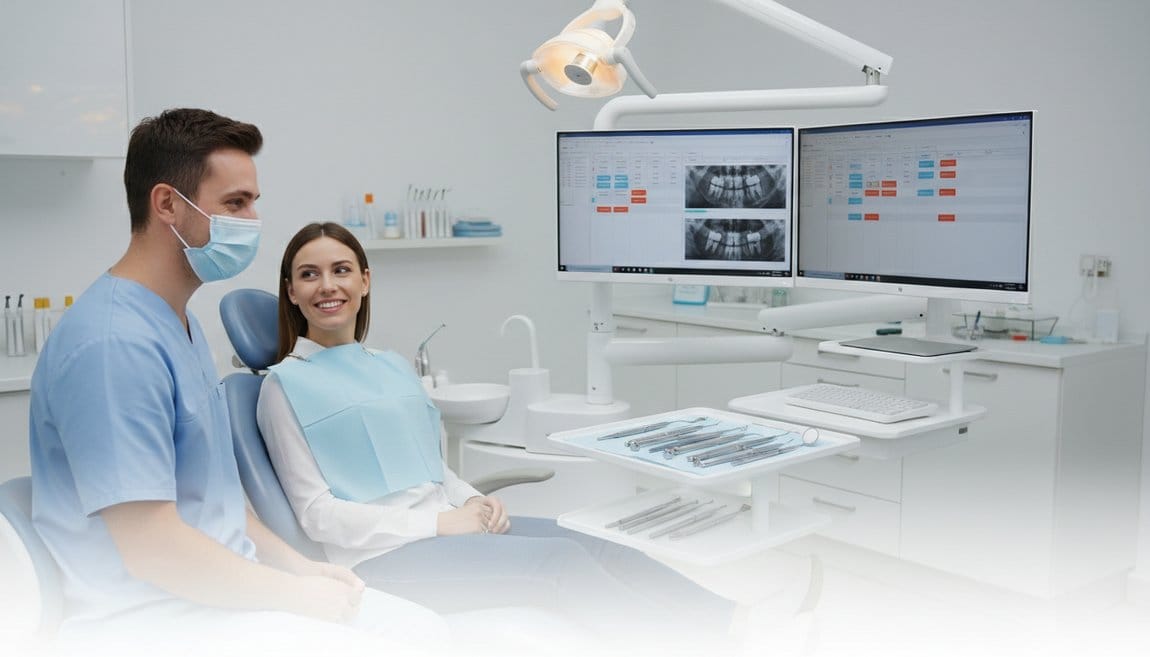
Inside the operatories, each chair typically has a dedicated PC connected to chairside imaging acquisition software, digital X-ray sensors or phosphor plate readers, intraoral cameras, and the charting module of the practice management system. In practices that have invested in 3D imaging, a CBCT unit adds a dedicated acquisition workstation and generates image files large enough that a slow or congested network makes viewing painful mid-appointment.
Behind the scenes, a server or cloud-hosted service stores all imaging data and the core practice database. Wi-Fi access points serve mobile devices, tablets for digital intake forms, and sometimes portable intraoral cameras. A router, a business-grade firewall, and one or more network switches tie everything together.
The interdependencies are the real risk. If the imaging server drops or the network segment carrying imaging traffic becomes congested, every single operatory can lose access to X-rays at once. Dental office IT services that don’t understand this architecture will chase symptoms at individual workstations while the whole practice sits idle.
Clinical and Business Risks of Weak Dental IT
The business case for solid dental practice IT support is easiest to make when something breaks badly. But the daily cost of weak IT is just as real, even when nothing officially goes down.
Clinical risks are serious. A provider who can’t pull up a patient’s current X-rays is making treatment decisions with incomplete information. Staff reverting to paper during an outage create documentation gaps and transcription errors when they re-enter data later. A patient with a documented allergy whose record is inaccessible because the system won’t load represents a genuine safety issue, not just an inconvenience.
The compliance exposure is a separate concern. HIPAA requires dental practices to safeguard protected health information, and weak IT creates specific vulnerabilities: unencrypted laptops, portable drives left in cars, unpatched workstations running outdated operating systems, shared logins that prevent audit trails. A breach involving patient records carries notification requirements, potential fines, and reputational damage that no practice wants. Generic small-business IT support typically doesn’t understand PHI handling requirements, imaging bandwidth demands, or why a server restart needs to happen at 7 PM instead of 2 PM on a Tuesday. That gap is exactly where it support for dental offices fills a need that commodity IT service cannot.
Why Dental-Specific IT Support Beats Generic IT
Dental practice IT support isn’t just standard managed services with a dental sticker on it. The technical knowledge required is different in specific, practical ways.
A technician who understands dental imaging software knows that a driver conflict on an acquisition PC can silently corrupt image metadata, that certain CBCT systems require a dedicated GPU and fail unpredictably when that GPU driver lags a version behind, and that some practice management platforms have database engines that need hands-on configuration to survive a server migration intact. These are not skills you develop supporting retail shops or law firms.
Dental practice IT support also demands understanding of physical environments that generic IT providers simply haven’t seen. Operatories in older buildings often have limited wall space, awkward cable runs through rooms with X-ray shielding, and humidity from sterilization areas that shortens hardware lifespan. Scheduling any maintenance work requires coordination around hygiene and production blocks; a 45-minute maintenance window that a generic provider books at 10 AM on a Wednesday morning could cancel two hygiene appointments worth $300 to $500 in combined production.
The vendor coordination piece is underrated. Dental offices have equipment vendors, software vendors, imaging vendors, and clearinghouse vendors, and when something breaks, each one points at the others. A dental IT partner who knows the landscape coordinates that troubleshooting and owns the outcome instead of leaving front-desk staff to play telephone between four different tech support queues.
“In dentistry, a generic IT fix that ‘mostly works’ can still mean a full day of lost production.”
Core Components of Effective Dental Practice IT Support
Definition
Managed IT services for dental offices — Managed IT services for dental offices is a recurring, proactive support model where an external provider continuously monitors, maintains, and secures a practice’s technology environment, replacing the traditional “break/fix” approach where nothing gets attention until something already stopped working.
Network and Infrastructure Built for Imaging and Compliance
The network is the circulatory system of a dental clinic IT environment, and it needs to be designed for the actual workloads that dentistry creates.
Bandwidth and latency requirements in a multi-operatory practice are more demanding than most people expect. A single CBCT scan can generate image files of 300 MB to 1 GB. When three or four operatories are simultaneously pulling imaging data from a central server, a network that would perform fine in an accounting office starts showing strain. Wired connections using at least Cat6 cabling should carry all clinical imaging traffic. Wi-Fi handles mobile devices, tablets, and patient access, but relying on wireless for chairside imaging acquisition introduces variables that will cause problems eventually.
Network segmentation is where dental clinic IT intersects directly with HIPAA compliance. Patient-facing Wi-Fi must be isolated from the clinical network on a separate VLAN so a patient’s personal device cannot see or touch anything on the internal system. Payment processing should run on its own segment as well, which reduces PCI scope and limits the blast radius of any potential breach.
Remote access deserves specific attention because dentists increasingly review charts from home or from satellite offices. VPN connections with multi-factor authentication are the baseline. Any solution that involves opening RDP directly to a server without a VPN layer is a security problem I’ve seen in far too many dental offices during initial assessments.
Business-grade firewalls with application-aware filtering and intrusion detection should sit at the perimeter. Consumer-grade routers purchased at a big-box store do not belong in a HIPAA-covered environment. The cost difference between a proper firewall and a $150 retail device is minimal compared to the breach exposure of running without one.
Hardware and Device Management in Operatories
Managing hardware in dental operatories requires a different mindset than managing workstations in a standard office. The physical environment is hostile to computers in ways most IT providers don’t anticipate.
Chairside PCs sit near sinks, autoclave sterilizers, and disinfectant spray. Moisture and aerosolized cleaning agents work their way into vents and onto fans over months and years. Proper mounting, regular internal cleaning, and careful cable management are maintenance tasks that a dental practice IT support provider should be doing on a scheduled basis, not waiting for a machine to fail before opening it up.
Imaging hardware presents its own lifecycle challenges. Digital sensors, phosphor plate readers, and intraoral cameras connect to acquisition PCs through USB, serial, or proprietary interfaces. Driver compatibility between imaging hardware and the host operating system must be verified before any OS update or Windows patch deployment. I’ve seen imaging systems go dark after a standard Windows Update because the sensor driver wasn’t compatible with a new kernel build. In a dental practice, that’s a same-day emergency.
Central imaging servers need appropriate redundancy. RAID arrays provide protection against single-drive failures but are not a backup strategy. Storage capacity planning matters too: a practice doing full-mouth series and CBCT regularly can generate hundreds of gigabytes per year in image data, and a server that runs out of disk space mid-day creates a recovery situation at the worst possible time.
Lifecycle planning is an area where dental office IT services provide real value. A planned PC replacement cycle, typically every 4 to 6 years for dental operatory workstations, costs far less in total than emergency replacements of machines that fail suddenly during a patient day.
Software: Practice Management, Imaging, and Integrations
The software layer in a dental practice is where dental practice IT support earns its keep in ways that are often invisible until something breaks.
Practice management platforms handle scheduling, billing, charting, insurance claims, and treatment planning. Imaging software sits alongside or integrated with the practice management system, linking X-rays and photos to specific patient records. When that link works properly, a provider clicks a patient’s name and their full imaging history appears in seconds. When the integration is misconfigured, staff spend time manually searching image archives, images get orphaned from records, or the same patient ends up with two different IDs across systems.
Patching and version management require careful coordination in dental environments. A major version upgrade to either the practice management system or the imaging platform can break the integration between them. Updates should be tested on a non-production machine or during a controlled after-hours window, with a rollback plan in place before touching anything that touches imaging. Dental clinic IT providers who push updates automatically during business hours without understanding these dependencies have caused multi-day outages.
Role-based access configuration is a software-layer task that belongs in the IT support scope. Hygienists, assistants, front-desk staff, and providers should have access to exactly what their role requires, nothing more. This is both a HIPAA access control requirement and practical operational hygiene.
Backup, Business Continuity, and Disaster Recovery
A dental practice lives or dies by the accessibility of two things: the patient schedule and the clinical record. IT support for dental offices that doesn’t treat backup and recovery as a first-class concern is leaving practices exposed in ways that can end a practice entirely. The 3-2-1 backup principle applies here: three copies of data, on two different media types, with one copy offsite or in the cloud. For a dental office, this typically means a local backup appliance for fast recovery, plus a cloud backup for disaster scenarios like fire, flood, or ransomware. Cloud-only backup without a local copy means recovery takes far longer than most practices can accept.
Recovery objectives matter and should be defined explicitly. A practice that can tolerate losing at most four hours of data (RPO of four hours) and needs to be back online within two hours of a failure (RTO of two hours) needs a different, and more robust, backup architecture than a practice that could work from paper for a day if needed. These are real planning conversations, and dental office IT services that never have them with their clients are managing storage, not managing risk.
Testing restores is the piece most practices skip. Backup software that reports completed successfully has failed on restore in far more offices than I want to count. Aim to test at least one full restore quarterly. That test should cover both the schedule database and a representative set of imaging files, not just confirm that a backup log shows green.
Specialized and Cybersecurity-Focused Dental Office IT Services
Definition
Cybersecurity for dental practices — Cybersecurity for dental practices is the layered protection of patient health information, clinical systems, and financial data within a dental environment, encompassing technical controls, physical safeguards, and staff procedures rather than simply installing antivirus and declaring the practice secure.
“In a digital dental practice, cybersecurity is now as essential as sterilizing your instruments.”
Cybersecurity and HIPAA-Driven Protections
Dental practices are attractive ransomware targets. They hold valuable PHI, they often run lean IT budgets, and their operational model creates real pressure to pay a ransom quickly rather than lose days of production recovering from backups. Small and mid-sized practices, including solo and two-doctor offices, have been hit by ransomware, phishing, and business email compromise attacks at increasing rates over the past several years.
The security baseline for any dental clinic IT environment should include endpoint protection on every workstation and server (not just traditional antivirus but behavioral detection), a business-grade firewall with active threat intelligence, email filtering with attachment sandboxing, and full-disk encryption on all laptops and portable drives. Multi-factor authentication must protect any remote access to the practice network, full stop.
Role-based access control limits damage from compromised credentials. If a front-desk workstation is breached, an attacker who can only access scheduling data is less dangerous than one who can also pull full clinical records and billing data. HIPAA’s minimum-necessary access standard maps directly to this control.
Physical security is part of the picture too. Server equipment should be in a locked closet, not sitting under a desk in a shared space. Screens in operatories should have privacy filters to prevent incidental viewing by patients in adjacent chairs. Old hard drives being decommissioned need secure wiping or physical destruction, not disposal in the trash.
Log monitoring and alerting give practices visibility into what’s happening on their network. Suspicious login attempts, large data transfers at unusual hours, and service failures can all appear in logs hours or days before a situation becomes a full incident. Dental office IT services that include active log review provide an early warning capability that reactive support simply cannot match.
Dental office IT services that include a formal security baseline review can benchmark a practice against HIPAA’s Security Rule technical safeguards and identify which gaps carry the most risk. Cyber liability insurance underwriters are increasingly asking these same questions, and practices that can answer them confidently are better positioned on coverage and premiums.
Cloud, Remote Work, and Tele-dentistry Considerations
Cloud-hosted practice management is increasingly common, particularly for newer practices and multi-location groups. The operational benefits are real: reduced on-premises hardware, automatic updates managed by the vendor, and accessible scheduling from any authorized device. The risks are equally real: the practice becomes entirely dependent on internet connectivity, and any outage at the cloud vendor or the practice’s ISP stops operations immediately.
IT support for dental offices operating in a cloud-heavy model should include a secondary internet connection. A business-class 4G or 5G failover router that activates automatically when the primary ISP goes down can keep a cloud-hosted practice running through what would otherwise be a complete shutdown. The monthly cost of a failover connection is a fraction of one lost production hour.
Tele-dentistry and remote consultation workflows introduce additional considerations. Image sharing between locations or with specialists must happen over encrypted channels, not through consumer email attachments. Tele-dentistry visit notes need to land in the primary patient record, not in a separate platform silo that nobody can access when the patient comes in for an in-person visit. IT support for dental offices that includes proper integration planning for these tools prevents documentation gaps that create both clinical and compliance risk.
Remote chart review by providers working from home or traveling between locations requires the same security discipline as any remote access to PHI: VPN, MFA, and a device that meets the practice’s security baseline.
Proactive Monitoring, Helpdesk, and On-Site Response
The service model around dental practice IT support matters as much as the technical capabilities behind it. A responsive, knowledgeable helpdesk staffed by people who understand that “imaging is down in all four ops” is a same-day emergency is a different experience than a generic ticket queue. A co-managed IT services approach can blend internal and external expertise.
Remote monitoring agents running silently on servers and workstations can catch warning signs before they become failures: a server disk that’s 90% full, a backup job that failed overnight, a network interface generating excessive errors. Proactive remediation of these conditions is what separates managed dental practice IT support from a break/fix provider who only shows up after something explodes.
Defined SLAs need to reflect dental operational reality. Production-stopping issues, like imaging server failure or practice management database corruption, warrant same-day or better response commitments. Non-critical issues like a single workstation running slowly can follow a standard queue. An IT partner who treats every issue with the same urgency level either wastes resources or, more dangerously, treats a clinical emergency with routine priority.
On-site response remains necessary for hardware failures, new equipment installs, and office reconfigurations. A technician who has been in the office before, knows the cable runs, and has a relationship with the clinical team can resolve issues in half the time of someone walking in cold. That relationship investment is a practical efficiency, not a soft benefit.
Business Benefits of Outsourcing Dental Practice IT Support
Uptime, Chairside Efficiency, and Patient Experience
The operational day in a practice with solid dental practice IT support looks different from one that’s limping along on aging equipment and reactive support. It’s a difference the entire team notices.
When imaging loads in under two seconds, providers can focus on the patient in front of them instead of waiting for a screen to respond. When the schedule system is available from open to close without a single spinning wheel interruption, front desk staff can manage check-in, insurance verification, and checkout without falling behind. That efficiency compounds across a full patient day.
Staff morale is an underappreciated factor in dental clinic IT planning. Dental assistants and hygienists who spend minutes of every appointment waiting for a frozen computer accumulate frustration that affects retention. Front-desk staff who have to apologize to patients for the computer being slow again are in an uncomfortable position that erodes confidence in the practice’s overall competence. Reliable dental practice IT support eliminates the most common sources of that friction.
Practices with solid IT infrastructure can also add new clinical capabilities, like digital impression scanning, AI-assisted X-ray analysis, or same-day restorative workflows, without technology bottlenecks blocking adoption. Growth opportunities that depend on technology don’t stall waiting for IT to catch up.
Predictable Costs and Strategic Upgrades
Break/fix IT billing creates unpredictable expense spikes at the worst times. An emergency server replacement in the middle of a busy week carries labor costs 1.5x to 2x higher than planned work, plus the cost of overnight hardware shipping, plus the production loss during recovery.
Hardware refresh planning is a tangible example of the value. A practice that replaces two or three workstations per year on a rolling 5-year cycle never faces the situation of eight machines all reaching end-of-life simultaneously with no budget set aside. That kind of lifecycle visibility is standard in a managed IT engagement and nearly impossible to maintain informally.
The strategic advisory piece matters most during growth events: adding a second location, bringing in a CBCT unit, acquiring another practice, or converting from film to full digital. Dental office IT services that understand the practice’s direction can plan the IT side of those projects months ahead, which is almost always cheaper and less disruptive than retrofitting IT after the clinical decisions have already been made.
Leveraging Specialized Expertise, Not Just “Computer Help”
The difference between generic IT help and real dental office IT services shows up most clearly when something complicated breaks and multiple vendors are involved.
When a CBCT acquisition fails and the imaging vendor says it’s a Windows permissions issue and the IT provider says it’s a driver conflict and the practice management vendor says their software is fine, somebody needs to own the resolution. A dental-focused IT partner who has worked through that exact scenario before can cut through the finger-pointing, reproduce the issue, and drive it to a fix without the practice’s staff serving as the intermediary between three different tech support teams.
Office moves and new operatory buildouts are another place where specialized knowledge pays off. Understanding cable routing around X-ray shielding, knowing the power requirements for imaging equipment, and coordinating the IT side of a new construction or renovation requires experience that a generalist provider typically doesn’t have.
Dental practice IT support that understands clinical prioritization also handles ticket triage better. Imaging down in the operatories gets a different response than a back-office printer jamming. Those priority distinctions are obvious to someone who has spent time in dental environments and completely non-obvious to someone who hasn’t.
The Dental IT Health Check: How to Evaluate and Improve Your Dental Clinic IT
Formula
If a system failure would stop you from seeing patients today, that system needs at least two independent layers of protection.
Step 1 – Assess Your Critical Systems and Downtime Impact
The first step in evaluating dental clinic IT maturity is mapping the systems that directly affect patient care and revenue to their actual failure risk.
Start with the short list: practice management platform, imaging system, internet connection, email, payment processing, and e-prescribing. For each one, ask two questions. First: if this failed right now, how long before patient care is affected? Second: what is the recovery plan, and who executes it?
Many dental practices, when they work through this exercise honestly, discover that their imaging server has no redundancy, their practice management database backup has never been tested, and their recovery plan for an internet outage is call the ISP and wait. That’s not a criticism; it’s a starting point. The goal of this step is to document single points of failure in dental clinic IT so they can be prioritized and addressed.
For it support for dental offices, this assessment conversation is something a prospective IT partner should be willing to have before any contract is signed. A provider who doesn’t ask about your critical systems in the first meeting isn’t approaching this as a clinical environment.
Step 2 – Review Your Security, Backups, and Compliance Basics
Security and backup hygiene in dental offices often drifts over time without intentional oversight. Staff turnover creates login accounts that never get deprovisioned. Laptops get taken home without encryption ever being enabled. Backup software updates itself but nobody checks whether the jobs are actually completing.
A practical self-check covers these questions:
- Do you know exactly where your backups live (local appliance, cloud, both) and when they last ran successfully?
- Has anyone performed an actual restore test in the past 12 months, with documentation of what was recovered and how long it took?
- Are all laptops and portable drives with patient data encrypted?
- Does every staff member have a unique login, and are terminated employees’ accounts deactivated within 24 hours of departure?
- Is multi-factor authentication enforced on any system accessible from outside the office network?
- Are software updates centrally managed, or does each workstation update independently (or not at all)?
Dental office IT services that include a formal security baseline review can benchmark a practice against HIPAA’s Security Rule technical safeguards and identify which gaps carry the most risk. Cyber liability insurance underwriters are increasingly asking these same questions, and practices that can answer them confidently are better positioned on coverage and premiums.
Step 3 – Evaluate Support Processes and Vendor Coordination
“Who do we call when something breaks?” is a question that dental practices should be able to answer without hesitation. Many can’t, and that’s a process risk as serious as any technical gap.
A common scenario in small practices: one staff member who is “good with computers” handles IT issues informally, alongside their clinical or administrative role. When that person is on vacation or leaves the practice, institutional IT knowledge leaves with them. There is no documentation, no vendor contact list, and no one who knows the server room password.
Dental practice IT support addresses this by serving as the single point of contact for all technology issues in the practice. When the imaging vendor needs to coordinate a software update, the IT partner handles it. When the internet goes down, IT calls the ISP and manages the escalation. When a workstation fails in the middle of a patient day, there is a defined number to call with a defined SLA on response.
Practices should document at minimum: the IT support contact and after-hours escalation process, credentials stored securely (not on a sticky note), and a list of all active vendor support contracts with account numbers and contact information. This documentation doesn’t need to be elaborate. A single shared document that the practice owner and office manager can access is enough to transform a chaotic outage into a managed one. A dental practice IT support partner should help build and maintain this.
Step 4 – Build a 12-18 Month Dental IT Improvement Roadmap
After working through the first three steps, most practices have a list of improvements that ranges from urgent to eventual. Grouping them into a phased improvement roadmap makes the scope manageable and the budget predictable.
Immediate risk fixes belong in the first 30 to 60 days: no working backup, unsupported server operating systems, no endpoint protection, shared login credentials. These are the gaps that create existential exposure if left unaddressed. A practice running Windows Server 2012 without extended security updates is not a minor compliance concern; it’s a vulnerability actively exploited by ransomware operators.
Three to six month projects include infrastructure improvements that require planning but aren’t critical failures: network reconfiguration with proper VLAN segmentation, firewall replacement, MFA rollout across all remote access, and encryption deployment on laptops. These projects need scheduled downtime, staff communication, and sometimes vendor coordination, which is why they belong in a planned phase rather than an emergency sprint.
The 12 to 18 month horizon covers strategic upgrades: PC refresh for aging workstations, server replacement or migration to cloud-hosted services, expanded imaging capabilities, or adding a second location. Dental office IT services that understand the practice’s clinical goals can align these upgrades with the practice’s growth trajectory rather than just reacting to hardware failures.
Dental clinic IT improvement doesn’t have to happen all at once. A realistic roadmap shared with a qualified IT partner converts an overwhelming list of gaps into a structured plan with timelines, costs, and accountable owners.
Conclusion
A dental practice that delivers excellent clinical care and then operates on unreliable, unsecured technology is carrying a risk that patients can’t see until something goes wrong. When something does go wrong, the impact is immediate: care is interrupted, data may be compromised, and trust takes a hit that’s hard to recover from one online review at a time.
Reliable it support for dental offices is not a luxury for large group practices. It is the operational infrastructure that every digital dental practice depends on, regardless of size. Run through the Dental IT Health Check outlined in this article, identify the gaps that matter most, and have a direct conversation with a qualified IT partner about a realistic roadmap. At On-Site Technology, we work with practices across NJ, NY, and FL on exactly this kind of structured engagement. Strong dental office IT services start with an honest assessment of where you are today.
FAQ: Common Questions About Dental Office IT Services
What’s the difference between regular IT support and specialized IT support for dental offices?
Standard IT support covers general networking, workstations, and software without any specific knowledge of clinical environments or healthcare regulations. IT support for dental offices adds expertise in imaging hardware and software integration, HIPAA Security Rule requirements, clinical workflow prioritization, and the vendor ecosystem specific to dentistry. That specialization determines whether a technician resolves an imaging integration failure in two hours or two days.
Is my practice too small to benefit from managed dental practice IT support?
No. Solo and two-doctor practices are often more exposed than larger groups precisely because they have less internal IT capacity and fewer resources to absorb an unplanned outage or breach. Managed dental clinic IT services scale to practice size; a solo practice doesn’t need enterprise-level infrastructure, but it does need the same security and backup fundamentals as any larger organization. The per-seat cost of managed support at small practice scale is typically offset by eliminating even one or two emergency service calls per year.
How often should we replace computers and servers in a dental office?
Operatory workstations typically reach functional end-of-life at 4 to 6 years, depending on workload and environment. Chairside machines in humid operatory conditions may need replacement closer to 4 years; back-office workstations with lighter loads can often go 5 to 6. Servers supporting imaging databases warrant more conservative planning: 5 years before replacement evaluation, with a hardware refresh or migration to cloud services typically completed before year 7. Running imaging or practice management databases on hardware past its manufacturer support window is a reliability and compliance risk.
Can we keep our current dental software if we switch IT providers?
Yes. A qualified IT partner works with whatever vendor stack the practice already uses. Switching IT providers should not require changing practice management platforms, imaging software, or any clinical application. A good onboarding process includes a full audit of current software, licenses, vendor support contracts, and integration configurations so the incoming provider can support everything already in place and identify any gaps or risks.
How do we know if our backups and security are good enough?
The honest answer is that you probably don’t know without a professional assessment. Most practices that believe their backups are working haven’t tested a restore in over a year, and many have never tested one at all. Dental office IT services that include a technology health assessment will review backup jobs, test restore capability, audit security configurations, and document gaps with specific remediation steps. That assessment, not a vendor checklist or a gut feeling, is the right baseline.
Need Help With IT Services?
On-Site Technology helps dental practices in NJ, NY, PA, and FL stay open, compliant, and productive with proactive Dental IT Services built for imaging, clinical workflows, and HIPAA security.
Our team delivers predictable support, lifecycle planning, and rapid response so the practice can focus on patients instead of technical emergencies.